
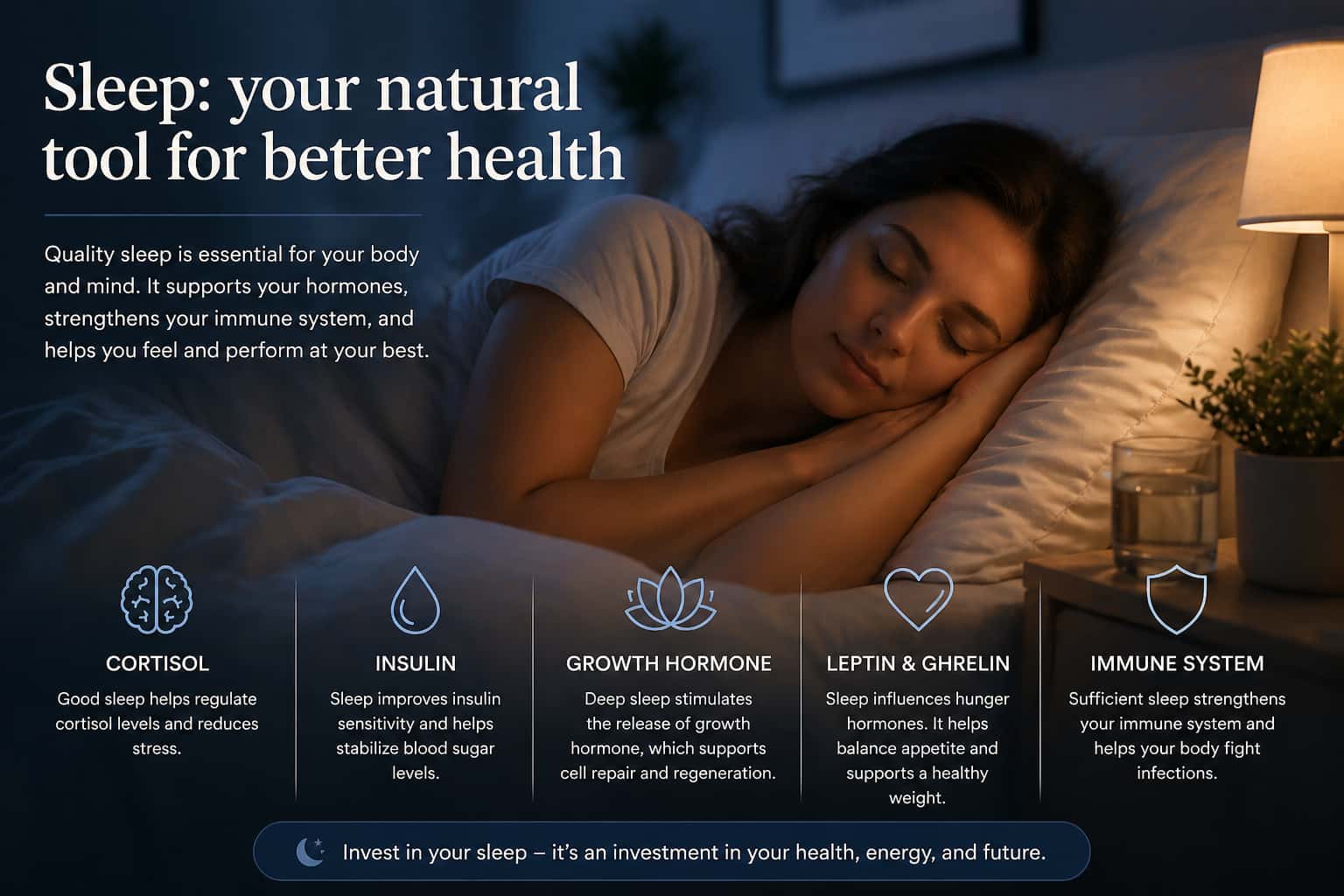
The most underrated health tool you already have
When people want to lose weight or get healthier, the first things they think about are diet and exercise. Sleep rarely makes the list. And yet, without enough quality sleep, both diet and exercise become significantly less effective — sometimes working against you entirely.
A large review of sleep research published in Obesity Reviews found that short sleep duration is consistently associated with higher body weight and obesity across all age groups. [1] This isn't a coincidence. Sleep directly controls the hormones that regulate your hunger, your cravings, and your ability to burn fat.
You can have the best diet in the world. But if you're sleeping 5 hours a night, your body is working against every good decision you make.
What sleep deprivation does to your hunger hormones
Your body uses two key hormones to manage hunger: ghrelin and leptin. Ghrelin tells your brain you're hungry. Leptin tells your brain you're full. When you don't sleep enough, ghrelin goes up and leptin goes down — at the same time.
A landmark study by Spiegel et al. published in PLOS Medicine measured this directly. After just two nights of restricted sleep (4 hours), participants had 28% more ghrelin and 18% less leptin compared to when they slept 10 hours. They reported significantly more hunger and appetite — especially for high-calorie, high-carbohydrate foods. [2]
In other words: one bad night's sleep doesn't just make you tired. It makes you hungrier, it reduces your sense of fullness, and it pushes your cravings toward exactly the foods you're trying to avoid.
What happens to your hormones after poor sleep
(hunger hormone) ↑
(fullness hormone) ↓
to cause this effect
Based on Spiegel et al. (2004), PLOS Medicine — after just 2 nights of 4-hour sleep restriction
Sleep duration vs. weight loss effectiveness
Based on Nedeltcheva et al. (2010), Annals of Internal Medicine — calorie-restricted diet with different sleep durations
Sleep and fat loss — the research is clear
A study by Nedeltcheva et al. put two groups on the exact same calorie-restricted diet. The only difference was sleep: one group slept 8.5 hours, the other 5.5 hours. Both groups lost weight — but the composition of that weight loss was dramatically different.
The well-rested group lost 55% of their weight as fat. The sleep-deprived group lost only 25% as fat — and lost significantly more muscle mass instead. [3] Less fat lost, more muscle lost, same diet. Sleep wasn't a bonus. It was the deciding factor.
Why this matters more than your diet plan
This is the part most health advice skips. You can optimise your macros, track every calorie, and hit the gym five times a week — but if you're running on 5 or 6 hours of sleep, you're fighting against your own biology every single day.
Your body treats sleep deprivation as a stress signal. Cortisol rises. Your body holds onto fat, especially around the abdomen. Your muscles don't recover properly from exercise. Your decision-making weakens — making it harder to stick to good habits when temptation hits.
Sleep isn't passive recovery. It's active rebuilding. Every hour of quality sleep is doing work that no supplement or meal plan can replicate.
If you had to choose between an extra hour of sleep and an extra hour at the gym, the sleep would often do more for your health. That's not an excuse to skip training — it's a reminder of what we consistently undervalue.
Practical steps to use sleep as a tool
The goal isn't perfection. It's consistency — the same principle that applies to every other part of your health journey. Here's what actually moves the needle:
- Aim for 7 to 9 hours. Most adults need this range. Below 7 consistently puts you in the hormonal danger zone described above.
- Keep a consistent wake time — even on weekends. Your circadian rhythm responds to consistency, not just duration.
- Cool your room down. Core body temperature drops during sleep. A cooler room (around 18°C / 65°F) supports this process and improves sleep quality.
- Cut screens 30 to 60 minutes before bed. Blue light suppresses melatonin — the hormone that signals your body it's time to sleep.
- Don't eat heavily within 2 hours of sleep. Digestion competes with the restorative processes your body needs to run overnight.
The bottom line
Sleep is not a luxury. It is not something to optimise once everything else is in place. It is a foundational pillar of health — as important as what you eat and how you move. Possibly more so, because it determines how effective everything else actually is.
If you're struggling to lose weight, constantly hungry, low on energy, or finding it hard to stay consistent — before you change your diet or add another workout, ask yourself honestly: how well am I sleeping?
One small step today: pick a bedtime and stick to it this week. That's it. Start there.