What is the Mediterranean diet?
The Mediterranean diet is a dietary pattern inspired by the traditional eating habits of countries bordering the Mediterranean Sea — particularly Greece, southern Italy, and Spain — as observed in the 1950s and 1960s. The term was coined by American physiologist Ancel Keys, who studied the unusually low rates of heart disease in these populations compared to northern Europeans and Americans.
It is not a weight-loss diet in the prescriptive sense — no calorie counts, no food exclusion lists, no phases. It is better described as a food culture: a way of eating built around whole foods, plant foods, healthy fats (primarily olive oil), seafood, and shared meals. The research evidence that has accumulated around it is exceptional — making it the most well-studied dietary pattern in nutrition science.
The Mediterranean diet is not associated with any particular macronutrient ratio. It is moderate in carbohydrates, moderate in fat (mostly unsaturated), and moderate in protein. What distinguishes it is food quality and diversity — not a formula.
How does it work?
Three main mechanisms explain most of the evidence:
Anti-inflammatory effect
The Mediterranean diet is rich in polyphenols (from olive oil, vegetables, fruits, legumes, and red wine in moderation), omega-3 fatty acids (from oily fish), and dietary fiber. These compounds reduce systemic inflammation — a root driver of cardiovascular disease, metabolic disease, and accelerated aging. Refined carbohydrates and processed meats, which drive inflammation, are limited or absent.
Endothelial health
Olive oil contains oleocanthal, a compound with anti-inflammatory properties similar to ibuprofen, and oleic acid, a monounsaturated fat that improves endothelial function (the health of blood vessel walls). Better endothelial function means more flexible arteries and lower blood pressure over time.
Gut microbiome diversity
High fiber intake from legumes, whole grains, vegetables, and fruit feeds a diverse gut microbiome. Research increasingly links microbiome diversity to metabolic health, immune function, and even mental health. The Mediterranean diet consistently produces more diverse microbiome profiles than Western dietary patterns.
The Mediterranean diet is not a single, rigid protocol. Traditional populations in Greece, Italy, and Spain had slightly different eating patterns. What unites them: high plant food diversity, olive oil as the primary fat, fish several times per week, low red meat consumption, and social eating.
Benefits beyond the heart
Brain and cognitive health
The MIND diet (Mediterranean-DASH Intervention for Neurodegenerative Delay) combines elements of the Mediterranean diet with the DASH diet specifically for brain health. A 2015 study by Morris et al. found that high adherence to the MIND diet was associated with substantially slower cognitive decline — equivalent to being 7.5 years younger in cognitive age — and a 53% reduction in Alzheimer's risk in those with highest adherence.
Depression and mental health
Multiple studies have linked higher Mediterranean diet adherence to lower rates of depression. A 2017 randomised controlled trial (the SMILES trial) found that dietary intervention based on Mediterranean principles produced significant reductions in depressive symptoms compared to social support alone. Food and mood are more tightly connected than most clinical settings acknowledge.
Longevity
The Mediterranean diet is associated with telomere length — a biological marker of cellular aging. A 2014 study in BMJ found that every 1-point increase in Mediterranean diet adherence score was associated with longer telomeres, suggesting a direct relationship with biological aging rate.
Type 2 diabetes prevention
High fiber content, low refined carbohydrate load, and anti-inflammatory properties contribute to improved insulin sensitivity. Multiple meta-analyses have found Mediterranean diet adherence significantly reduces the risk of developing type 2 diabetes.
What it includes (and what it limits)
Extra virgin olive oil is the primary fat — used for cooking, dressing, and dipping. Rich in oleic acid and polyphenols. The PREDIMED trial used 1 litre per week per family as the intervention dose. Not a condiment — a staple.
Seasonal vegetables at every meal. Legumes (lentils, chickpeas, beans) 3–4 times per week as a protein source. The fiber and polyphenol content of this category drives much of the diet's microbiome and anti-inflammatory benefits.
Fatty fish (sardines, mackerel, salmon) 2–3 times per week provides EPA and DHA — the omega-3 fatty acids with the strongest cardiovascular and brain evidence. White fish adds lean protein with minimal processing.
Bread, pasta, and rice as whole grains (not refined). A handful of nuts (walnuts, almonds) daily. Both contribute fiber, vitamins, and sustained energy without the blood sugar spike of refined carbohydrates.
Traditional Mediterranean consumption includes red wine with meals — 1 glass/day for women, up to 2 for men. The research association may partly reflect lifestyle factors rather than alcohol itself. Non-drinkers should not start for health reasons.
Red meat is eaten rarely — a few times per month at most. Processed meats, refined carbohydrates, added sugars, and ultra-processed foods are largely absent from traditional patterns. This is as important as what the diet includes.
What the research says
The Mediterranean diet has one of the most extensive evidence bases in nutrition science. Below are five landmark studies that define what we know.
The PREDIMED (Prevención con Dieta Mediterránea) study randomised 7,447 adults at high cardiovascular risk to either a Mediterranean diet supplemented with olive oil, a Mediterranean diet supplemented with nuts, or a low-fat control diet. After 5 years, both Mediterranean diet groups showed approximately 30% reduction in major cardiovascular events (heart attack, stroke, cardiovascular death) compared to the control group. This remains the largest Mediterranean diet RCT ever conducted.
This French randomised trial followed 605 patients who had already had a heart attack. Those assigned to a Mediterranean-style diet showed a 70% reduction in cardiac death and non-fatal heart attacks over 4 years compared to the control group. The trial was stopped early because the benefit was considered too large to continue withholding from the control group.
This observational study of 923 older adults developed the MIND diet score — a version of the Mediterranean diet optimised for brain health. Participants with the highest MIND diet adherence had a 53% lower rate of Alzheimer's disease over 4.5 years compared to those with the lowest adherence. Even moderate adherence was associated with a 35% risk reduction.
This updated systematic review and meta-analysis pooled data from 12 cohort studies with over 1.5 million participants. Higher adherence to the Mediterranean diet was associated with significant reductions in overall mortality, cardiovascular mortality, cardiovascular disease, cancer incidence, and Parkinson's and Alzheimer's disease. This is one of the most comprehensive population-level analyses of the diet's effects.
The Supporting the Modification of lifestyle In Lowered Emotional States (SMILES) trial was the first RCT to test a dietary intervention specifically for depression. Participants assigned to Mediterranean diet counselling showed significantly greater reductions in depressive symptoms than those receiving social support only. 32% achieved remission in the diet group vs 8% in the control group.
The Mediterranean diet is backed by some of the largest and most rigorous nutrition trials ever conducted. Its benefits span cardiovascular disease, cognitive decline, mental health, longevity, and metabolic health — making it unique among dietary patterns in the breadth and depth of its evidence.
How to follow it
The Mediterranean diet requires no phase protocol or strict meal plan. It is a pattern shift — achievable through six practical steps.
| Step | Action | Example |
|---|---|---|
| Step 1 | Switch your cooking fat | Replace butter, sunflower oil, and margarine with extra virgin olive oil for all cooking and dressings. |
| Step 2 | Add vegetables to every meal | At least half of each plate should be vegetables — any form (raw, roasted, steamed, sautéed in olive oil). |
| Step 3 | Eat fish twice a week | Replace two meat meals per week with fatty fish (sardines, mackerel, salmon) or white fish. |
| Step 4 | Add legumes three times a week | Lentil soup, chickpea salad, hummus, bean stew — legumes as the protein source three times per week. |
| Step 5 | Replace refined grains | Switch white bread, white pasta, and white rice to whole grain versions. Reduce but do not need to eliminate. |
| Step 6 | Reduce ultra-processed foods | The simplest rule: if it comes in packaging with more than 5 ingredients, eat it rarely. Focus on whole foods. |
You do not need to live in Greece to follow this diet. The Mediterranean diet is a pattern, not a geography. Extra virgin olive oil, sardines, lentils, seasonal vegetables, and whole grain bread are available everywhere and are generally affordable.
The Mediterranean diet has the strongest total evidence base of any dietary pattern — across cardiovascular disease, cognitive decline, mental health, longevity, and metabolic health. It is also the most livable long-term because it is built around real food and enjoyment rather than restriction. If you only follow one dietary guideline, make it this one.
Common mistakes
Mistake 1: Treating it as a weight-loss diet. The Mediterranean diet is primarily a health pattern, not a calorie-restriction protocol. Olive oil, nuts, and bread are calorie-dense. If weight loss is the goal, a Mediterranean approach combined with modest caloric awareness is the most evidence-based route — but the diet alone is not a guarantee of weight loss.
Mistake 2: Using low-quality olive oil. Many olive oils on supermarket shelves are refined, blended, or old — with minimal polyphenol content. Look for extra virgin olive oil with a harvest date within the last 12–18 months. The polyphenols in quality EVOO are a significant part of the health benefit.
Mistake 3: Eating too much bread and pasta. Traditional Mediterranean diets include modest portions of bread and pasta — not unlimited. In modern adaptations, refined pasta or bread in large quantities can undermine the blood sugar and metabolic benefits. Choose whole grain and control portions.
Mistake 4: Ignoring the legume component. Most people who "try the Mediterranean diet" eat more olive oil and fish but forget legumes. Legumes 3–4 times per week are one of the most consistent features of long-lived Mediterranean populations — and one of the most neglected in modern adoptions.
Mistake 5: Drinking wine for health reasons. The evidence for red wine specifically is contested — many researchers believe the association is confounded by lifestyle factors, not attributable to alcohol itself. If you already drink and enjoy wine with meals, moderate consumption fits the pattern. Starting to drink for health reasons is not supported by current evidence.
The short version
- The Mediterranean diet is the most studied dietary pattern in the world, with 30+ years of evidence across cardiovascular disease, cognition, depression, and longevity.
- PREDIMED (the largest RCT) showed a 30% reduction in major cardiovascular events. The Lyon Diet Heart Study showed 70% reduction in recurrence.
- It works through anti-inflammatory mechanisms (polyphenols, omega-3s, fiber), improved endothelial function (olive oil), and gut microbiome diversity.
- Foundation foods: extra virgin olive oil, seasonal vegetables, legumes 3–4x/week, fatty fish 2–3x/week, whole grains, nuts.
- Limited in: red meat (a few times per month), processed meats, refined carbohydrates, added sugars, ultra-processed foods.
- The MIND diet variant (Mediterranean + DASH) is associated with a 53% reduction in Alzheimer's risk at highest adherence.
- The SMILES trial found dietary intervention achieved 4x higher depression remission rates than social support alone.
- It is not a weight-loss protocol by design — but combining it with caloric awareness produces strong and sustainable weight outcomes.
Books we recommend
For those who want to go deeper into the Mediterranean dietary pattern and the research behind long-lived populations, these two books are excellent starting points.
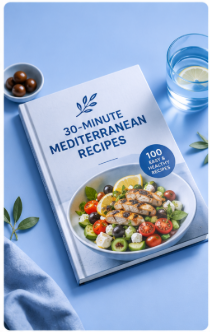
100 easy, healthy recipes designed for real life — ready in 30 minutes or less. Covers weight management, heart health, anti-inflammatory eating, meal prep, and family dinners. A practical entry point for anyone who wants to follow the Mediterranean pattern without spending hours in the kitchen.
- ✓ 100 recipes ready in 30 minutes — no complicated techniques
- ✓ Focused on heart health, weight management, and anti-inflammatory eating
- ✓ Includes meal prep guidance and weeknight dinner ideas
- ✓ Written for beginners — accessible ingredients, clear instructions

Dan Buettner studied the world's longest-lived communities — from Sardinia to Okinawa to the Greek island of Ikaria — and distilled their habits into a practical 4-week challenge. Mediterranean eating patterns are central to every Blue Zone. This book bridges the research on longevity with actionable steps for everyday life.
- ✓ Based on real populations living past 100, not lab studies
- ✓ Mediterranean eating patterns are at the core of every Blue Zone
- ✓ 4-week structured plan — actionable, not just theoretical
- ✓ Covers food, movement, sleep, and community together
References
-
1Estruch R. et al. (2013). Primary Prevention of Cardiovascular Disease with a Mediterranean Diet (PREDIMED). New England Journal of Medicine, 368(14), 1279–1290. PubMed: 23432189
-
2de Lorgeril M. et al. (1999). Mediterranean Diet, Traditional Risk Factors, and the Rate of Cardiovascular Complications After Myocardial Infarction. Circulation, 99(6), 779–785. PubMed: 9989963
-
3Morris MC et al. (2015). MIND diet associated with reduced incidence of Alzheimer's disease. Alzheimer's & Dementia, 11(9), 1007–1014. PubMed: 25681666
-
4Sofi F. et al. (2014). Accruing evidence about benefits of adherence to the Mediterranean diet on health: an updated systematic review and meta-analysis. Public Health Nutrition, 17(12), 2769–2782. PubMed: 24808109
-
5Jacka FN et al. (2017). A randomised controlled trial of dietary improvement for adults with major depression (the 'SMILES' trial). BMC Medicine, 15(1), 23. PubMed: 28137247